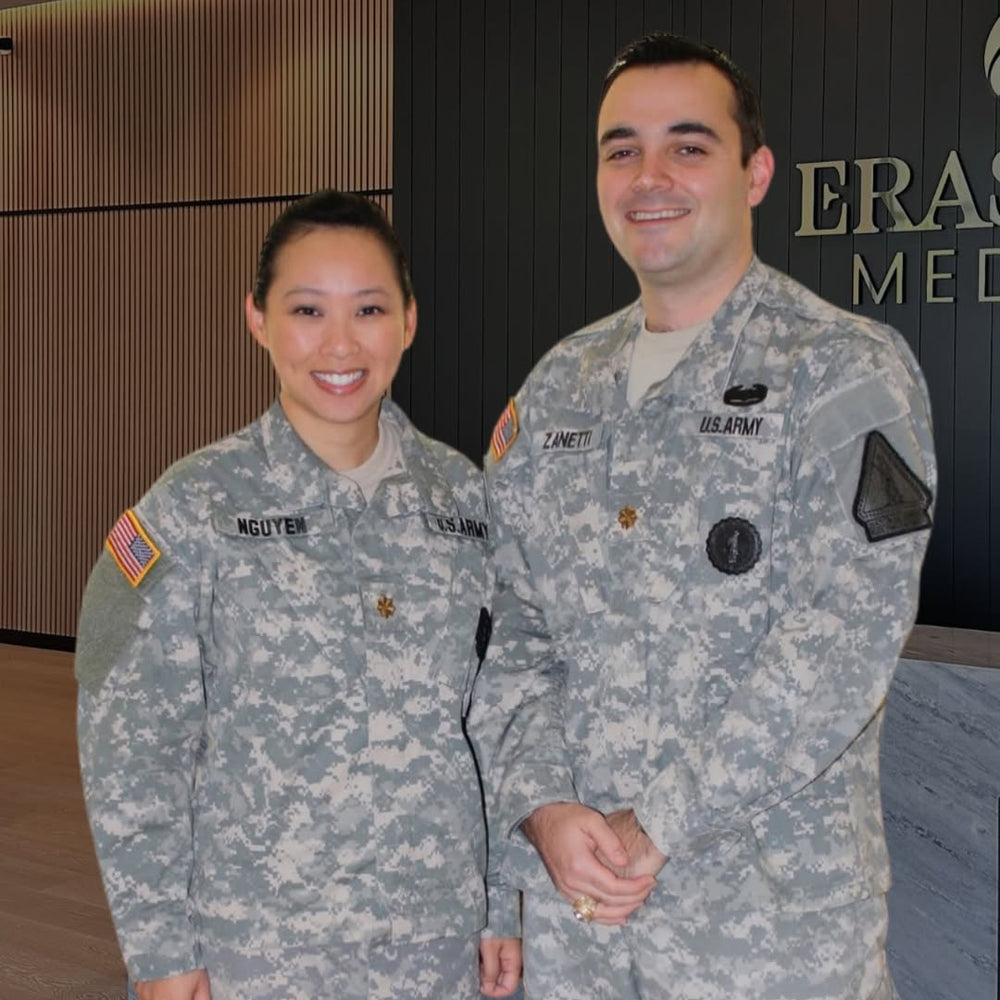
Michael Zanetti | @michaelrzanetti

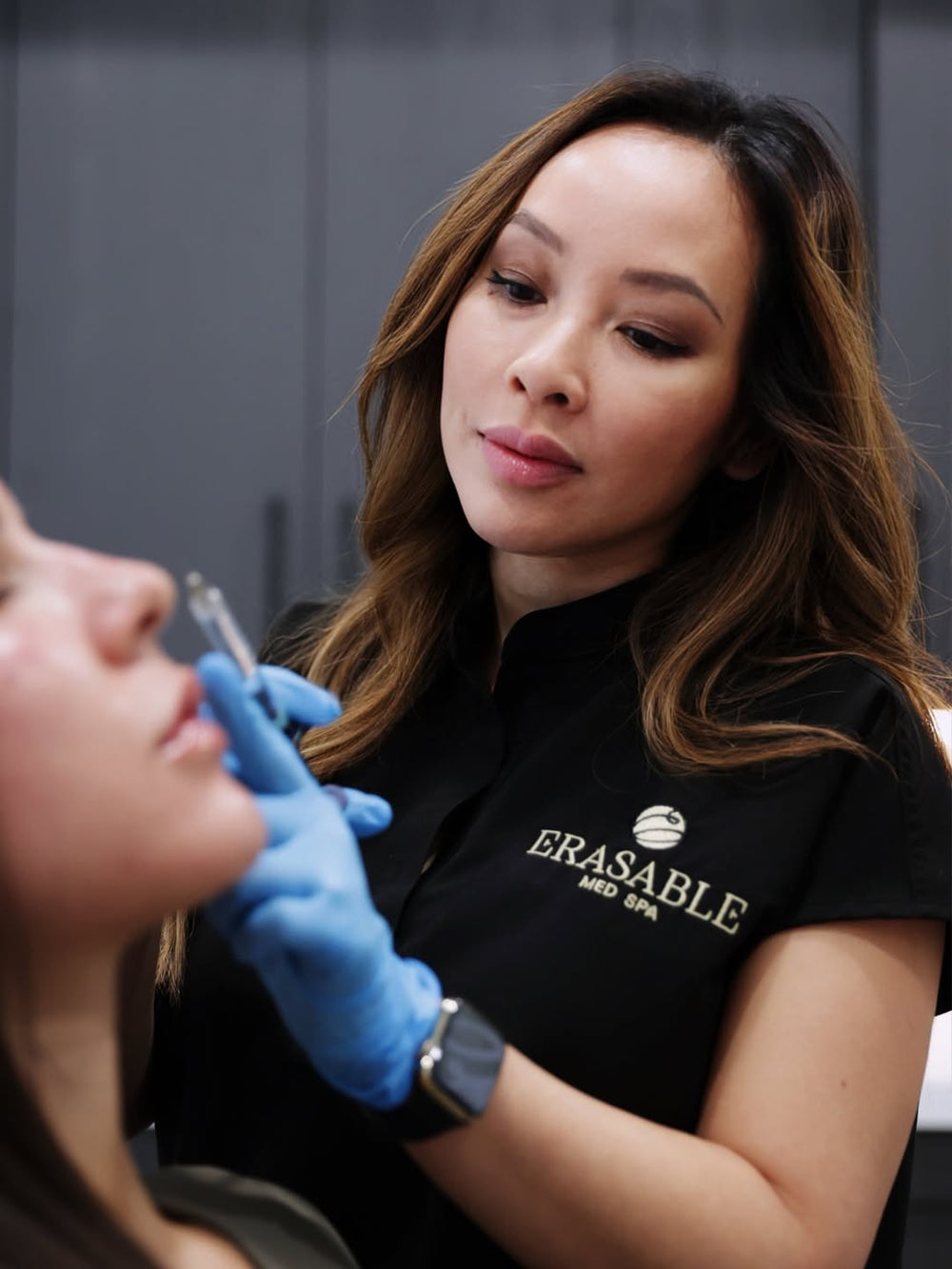
Loretta Nguyen Zanetti | @lorettaz_np
You both come from military backgrounds, with Loretta leading clinically and you on the business side. How did that dynamic shape the foundation of Eraseable, and what advice would you give to other provider-operator partners building a practice together?
The military gave us something most business schools can’t teach: clarity under pressure and the discipline to execute when the plan meets reality. Loretta spent over 18 years as an Army officer, rising to the rank of Lieutenant Colonel, while I served as a Major for 9 years and a combat veteran before earning my MBA from the Thunderbird School of Global Management. Those experiences shaped how we think about operations, accountability, and leadership, and they became the blueprint for Erasable.
From the beginning, Loretta owned the clinical side completely. She’s the one who identified the opportunity in laser tattoo removal while working in a military recruiting unit, where she saw firsthand how tattoos were limiting people’s ability to serve. That clinical insight and personal mission drove the founding of Erasable in 2014. My role was to build the infrastructure around her expertise: the financial modeling, the vendor relationships, the growth strategy, the systems that let a one-room operation with a single laser scale into a 5,200-square-foot flagship facility with dozens of devices.
The reason it works is because we respect the boundary. Loretta doesn’t second-guess my P&L decisions, and I don’t walk into a treatment room and tell her how to inject. That sounds simple, but it’s where most provider-operator partnerships fall apart. One person starts encroaching on the other’s domain, and suddenly you’re spending more energy managing internal friction than growing the business.
My advice to couples or partners building a practice together: define your lanes early and protect them. Write it down if you have to. The clinical lead needs full authority over patient care, protocols, and training. The business lead needs full authority over financials, marketing, and operations. You meet in the middle on strategy, hiring, and culture. And when you disagree (because you will), the person whose lane it falls in gets the final call. That structure has kept us aligned through over a decade of growth, a full facility buildout, and the expansion from a niche tattoo removal practice into a comprehensive medspa.


You’ve been very intentional about capturing and leveraging patient feedback. How do you operationalize that internally, and how has it influenced both retention and long-term growth?
We measure everything. That’s not a slogan; it’s an operating principle. Internal staff opinions, external patient feedback, vendor performance, how long services take, net promoter scores. If it touches the patient experience, we’re tracking it.
The system is straightforward. We ask for feedback both in person and electronically after every visit. Not just a satisfaction survey, but structured questions that give us actionable data on what’s working and what needs to change. We look at that data weekly. If a pattern shows up (a specific service running long, a touchpoint that patients keep mentioning), we address it in our next team meeting. It’s a continuous feedback loop, not an annual review.
Google reviews have been a major part of this. We’ve built up over 300 reviews, and that volume does real work for us. It drives SEO, builds trust in the local market, and creates a compounding effect: the more reviews we accumulate, the more authority we carry in the space. That authority is often the deciding factor when a prospective patient is choosing between us and another practice down the street.
But the real value of patient feedback isn’t marketing. It’s retention. When someone tells you exactly what they loved or what fell short, and you act on it visibly, you create loyalty that no discount or promotion can replicate. Patients who feel heard come back. They refer friends. They become advocates. Over 12 years of consistent double-digit growth, that feedback engine has been one of the most reliable drivers of our business.
The mistake I see other practices make is treating reviews as a vanity metric. They want 5 stars but they don’t build the internal process to earn them consistently. The reviews are the output. The system behind them is the asset.
Looking at today’s landscape, what do you see as the most common mistakes new medspa owners are making, and what would you prioritize if you were starting again today?
The biggest mistake is getting out over your skis financially. I see new owners signing leases on 3,000-square-foot spaces, buying 4 devices on day one, and hiring a full staff before they’ve treated their first patient. The med spa industry has a real problem with startup cost management, and most people underestimate how long it takes to build a patient base that supports that overhead.
When Loretta started Erasable in 2014, it was one room and one laser. That’s it. She didn’t need a flagship facility to prove the concept or build a reputation. She needed great clinical outcomes and a steady pipeline of patients who trusted her. The infrastructure came later, funded by revenue the business was actually generating.
The second mistake is neglecting the business fundamentals. Too many new owners are clinically excellent but have no framework for pricing strategy, margin analysis, patient acquisition cost, or lifetime value. They set prices by looking at what the practice next door charges. They run promotions that erode their margins without understanding the math. They don’t track the KPIs that actually tell you whether your business is healthy or bleeding out slowly.
If I were starting today, I’d prioritize three things. First, start lean and prove demand before you scale. Second, invest in a real practice management system from day one so you’re capturing data that lets you make informed decisions. Third, get business education early. Don’t wait until you’re 2 years in and confused about why revenue is growing but profit isn’t. The clinical skills get you in the door. The business skills determine whether you’re still standing in 5 years.
You’ve also expanded into training, both clinically and from a business perspective. Why do you think business education remains such a gap in aesthetics, and how can providers better prepare themselves?
The gap exists because the educational pipeline for providers was never designed to produce business owners. Nursing programs, PA programs, medical schools: they train exceptional clinicians. They don’t teach you how to read a balance sheet, negotiate a lease, build a compensation structure, or calculate your cost per acquisition. So you end up with incredibly skilled practitioners who open a practice and immediately face a set of problems their training never prepared them for.
That’s exactly why we built the Aesthetic Institute arm of Erasable. Loretta travels internationally as a trainer and speaker. She’s a Galderma GAIN trainer and a Sciton Luminary, training providers on clinical technique and device mastery. On the business side, we consult with practices across the country, reviewing their operations, identifying bottlenecks, and building strategies that are grounded in real numbers, not aspirational thinking.
What we’ve found is that the clinical training market is well-served. There are courses, certifications, manufacturer-sponsored programs, and hands-on workshops for nearly every modality. But the business education side is thin. Most of what exists is generic small-business advice repackaged with medspa branding. It doesn’t account for the nuances of this industry: the compliance requirements, the device financing structures, the patient lifecycle economics, the staffing models that actually work.
Providers who want to prepare themselves should start by treating the business side with the same rigor they bring to clinical learning. Find operators who’ve actually built and scaled a practice (not just consultants who’ve theorized about it). Study your financials monthly, not quarterly. Understand your margins by service line. And be honest about what you don’t know. The providers who struggle most aren’t the ones who lack business knowledge; they’re the ones who don’t realize they lack it until the cash flow problems become impossible to ignore.
When Loretta started Erasable in 2014, it was one room and one laser. That’s it. She didn’t need a flagship facility to prove the concept or build a reputation. She needed great clinical outcomes and a steady pipeline of patients who trusted her. The infrastructure came later, funded by revenue the business was actually generating.
The second mistake is neglecting the business fundamentals. Too many new owners are clinically excellent but have no framework for pricing strategy, margin analysis, patient acquisition cost, or lifetime value. They set prices by looking at what the practice next door charges. They run promotions that erode their margins without understanding the math. They don’t track the KPIs that actually tell you whether your business is healthy or bleeding out slowly.
If I were starting today, I’d prioritize three things. First, start lean and prove demand before you scale. Second, invest in a real practice management system from day one so you’re capturing data that lets you make informed decisions. Third, get business education early. Don’t wait until you’re 2 years in and confused about why revenue is growing but profit isn’t. The clinical skills get you in the door. The business skills determine whether you’re still standing in 5 years.

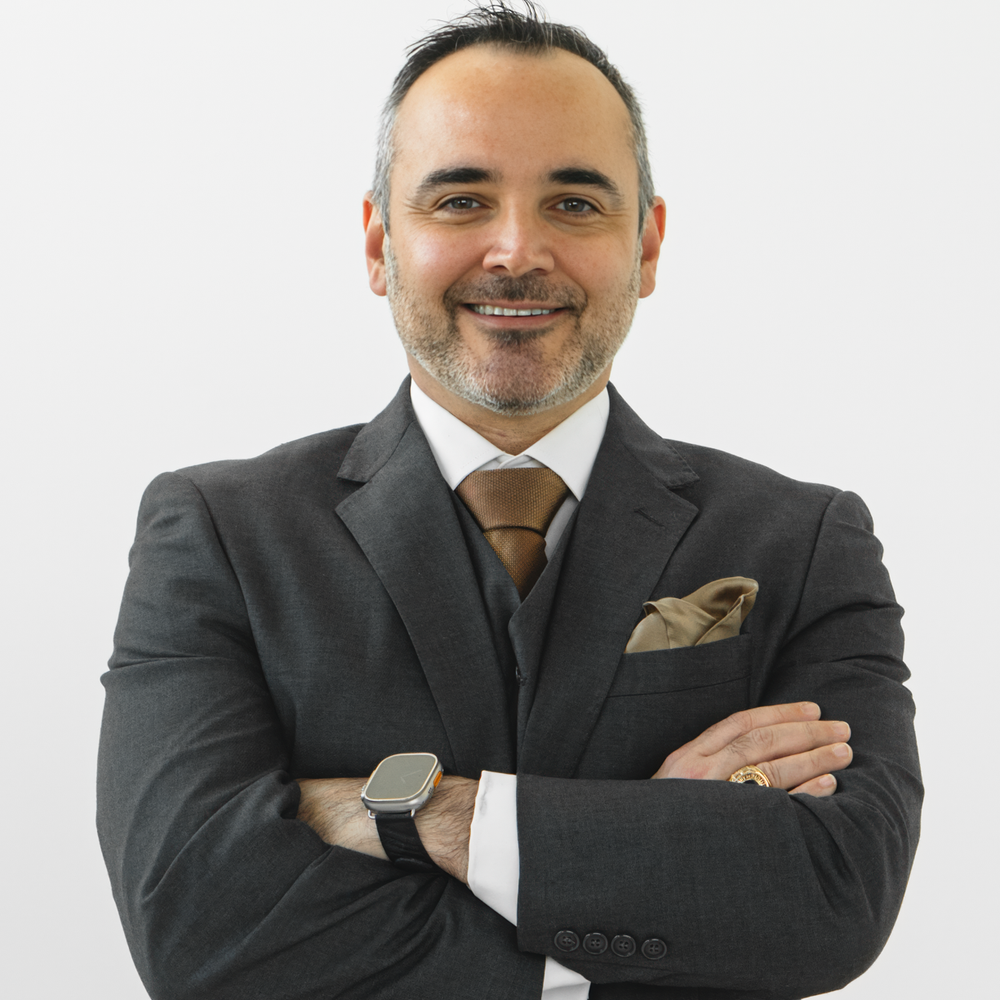
Erasable Medspa | Tampa, FL | @erasablemedspa
Through your involvement with AmSpa and broader industry initiatives, you’ve had a front-row seat to how the space is evolving. Where do you think the industry still needs more structure, standards, or accountability?
I co-chair AmSpa’s Florida State Chapter, and through that work and our training programs, we interact with practices at every stage of growth and across a wide range of operational maturity. The variance is striking. You have practices running at an incredibly high level, with proper medical oversight, robust protocols, and real quality standards. And then you have operations that are, frankly, cutting corners in ways that put patients at risk and drag the industry’s reputation down.
The most obvious gap is in standardized training requirements. The barrier to entry in aesthetics is too low in certain states. Someone can attend a weekend course, buy a device, and start treating patients with minimal oversight. That’s a problem. Clinical competence requires supervised training hours, ongoing education, and accountability structures that many practices simply don’t have in place.
The second gap is in business transparency. There’s very little standardized reporting or benchmarking available to practice owners. Most operators are flying blind when it comes to understanding whether their metrics are healthy relative to the industry. AmSpa has been working to close that gap, and organizations like ours contribute data and perspective, but we’re still in the early innings.
The third area is scope-of-practice enforcement. The regulations exist, but enforcement is inconsistent across states. That inconsistency creates confusion for patients and competitive imbalances for practices that are doing things the right way. The industry needs clearer, more uniformly enforced standards that protect patients and reward operators who invest in compliance.
I’m encouraged by the direction things are moving. AmSpa’s state chapter model is creating local networks of practice owners who hold each other accountable and share best practices. But there’s still a long way to go before the aesthetics industry has the kind of structural rigor that patients deserve and that reputable practices need to thrive.
You often speak about a “slow and steady” approach to growth. How do you balance that mindset with the pressure to scale quickly in such a competitive and fast-moving market?
The pressure to scale fast is real, and it comes from everywhere. Social media makes every competitor’s new device launch feel like an existential threat. Vendors push you to add services. Patients ask about the latest trend they saw on TikTok. And if you’re not careful, you end up chasing volume instead of building value.
Our approach at Erasable has always been to grow at the speed our fundamentals support. We started with tattoo removal. We got exceptionally good at it. We built a reputation around it. Then, as demand justified it and as we brought on clinical partners and expanded into a full-service aesthetic offering. That expansion happened over years, not months, and every new service line was backed by real patient demand and a clear path to profitability.
The “slow and steady” framing can be misleading. It doesn’t mean we lack ambition. Erasable has averaged double-digit growth for 12 consecutive years. We built out a 5,200-square-foot flagship space. We run a training institute that serves practices globally. None of that happened by accident or by standing still. But it happened because we didn’t overextend at any single point along the way.
The balance comes down to separating urgency from opportunity. Competitive pressure creates urgency: the feeling that you need to act now or get left behind. Real opportunity is supported by data: patient demand, margin potential, operational readiness. When those two align, we move decisively. When the urgency is just noise, we stay the course.
My advice to owners feeling that pressure: your practice doesn’t need to do everything. It needs to do the right things exceptionally well, and it needs the financial health to sustain those things through market cycles. A practice that grows 15% a year for a decade will outperform one that doubles in year one and stalls in year three. Every time.
You’ve built a reputation for delivering a highly elevated, results-driven patient experience. What are the non-negotiables in creating an environment where patients feel both confident in the outcomes and cared for throughout the process?
The first non-negotiable is clinical excellence. Full stop. No amount of interior design, branded merchandise, or concierge-level service saves you if the outcomes aren’t there. Patients come to us for results. Everything else, the environment, the communication, the follow-up, exists to support their confidence in those results and their comfort in the process.
The second is transparency in the consultation. We set expectations clearly and honestly. If a treatment isn’t right for someone, we say so. If results will take 6 sessions, we don’t promise 3. That honesty builds a kind of trust that converts into long-term relationships, not just single transactions. Patients who feel they were told the truth, even when the truth was “this will take longer than you’d like,” come back. Patients who feel oversold don’t.
The third is consistency. The experience a patient has on their first visit should match their fifth, their tenth, their twentieth. That requires systems: documented protocols, training standards, regular calibration across the team. It’s not enough for one provider to deliver a great experience. Every provider, every front-desk interaction, every follow-up communication needs to meet the same standard.
The fourth is follow-through. We close the loop with every patient. Post-treatment check-ins, feedback requests, personalized follow-up. That follow-through signals that we care about the outcome, not just the appointment. And it creates natural opportunities to deepen the relationship, address concerns early, and keep patients engaged with the practice over time.
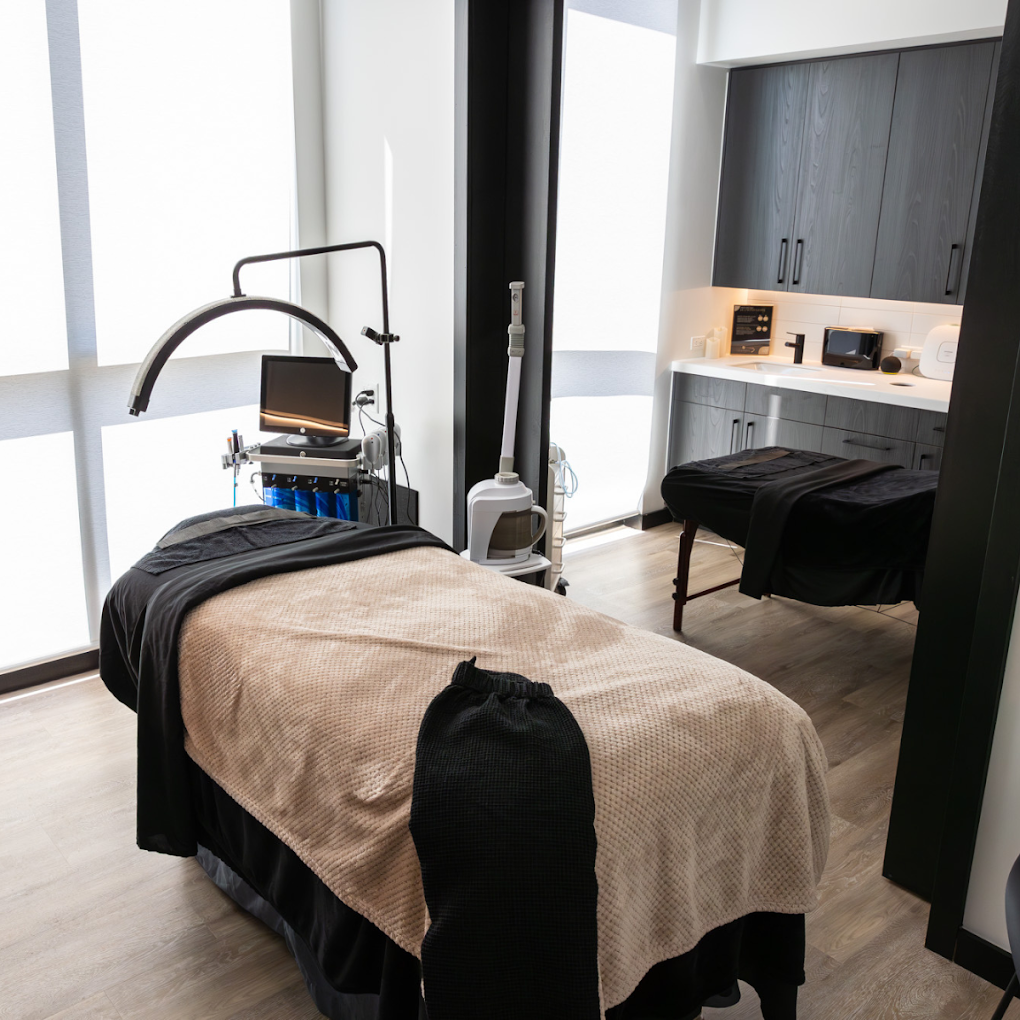
The physical environment matters too, and we’ve invested heavily in making Erasable feel warm, modern, and luxurious. But I’d argue the environment is a multiplier, not the foundation. A beautiful space with mediocre clinical work is a liability. An exceptional clinical team in a well-designed space is what creates the kind of patient experience people talk about and come back for.