In Practice: Whitney Hovenic, MD MPH, Founder and CEO @ SPOOGE | Double Board-Certified Mohs Surgeon and Dermatologist


Sunscreen use is pretty dismal- only about 9-12% of Americans wear sunscreen everyday but 1 in 5 Americans will develop skin cancer in their lifetime and if you live in a sunny or high altitude climate (Reno we get both!), your risk is likely higher. We know that regular use of an SPF 15 decreases your risk of skin cancer significantly but I still get people telling me everyday that they don't or they won't wear it. Even when I am in the middle of removing their skin cancer!
Most of the skin cancers I remove in my Mohs practice come from decades of small, everyday exposures: driving, walking the dog, sitting by a window. Beach vacations aren't the main cause. Patients often tell me, "But I always wear sunscreen when I go to the lake," and I wish more people understood that occasional use isn't where the protection comes from.
Traditional clinical messaging leans on warnings, statistics and scary photos, and it treats sunscreen like medicine. To a 22-year-old, skin cancer feels like a problem for someone decades older. If sunscreen feels like a chore or a lecture, it won't become a habit. Younger patients respond to products and messages that feel like they're part of their lives and gives them benefits beyond the SPF. It needs to not just protect but enhance their skin or at least not feel like a heavy sticky layer to get them to wear it everyday.
Fear doesn't work, especially with younger patients. It might get someone to buy a bottle once, but it doesn't build a habit. What works is meeting people where they already are. Younger patients care about their skin. They have skincare routines, they watch skincare content, and they care about glowing, even-toned skin. Sunscreen is the most effective anti-aging product there is, so I frame it that way: it's the last step of your morning routine, like brushing your teeth. Nobody brushes their teeth because they're afraid. They do it because it's automatic.
As physicians, we can also be more specific and practical. Instead of "wear sunscreen," we can say "put it on after your moisturizer every morning, keep a stick in your car or gym bag, and reapply if you're outside for more than a couple of hours." We can also ask what they don't like about sunscreen. Usually it's the greasiness, the white cast, or the smell, and once we know that, we can solve it. Once sunscreen is part of a routine someone already enjoys, compliance takes care of itself. Also making formulas that enhance the skin whether with a dewy glow or working seamlessly under makeup or not getting into their beard hair- it has to work for them and enhance their routine to increase compliance. I love how Dew Me makes my skin feel, so much that I put it on even if I am not going outside because it makes my skin more even and gives it a little glow and it is my go to. The SPF protection is just the added benefit.
UV exposure doesn't take the winter off, and it doesn't wait for a sunny day. Up to about 80% of UV rays can pass through clouds. UVA, which makes up the vast majority of the UV reaching us, penetrates glass, so you're exposed in your car and next to your office window. UVA drives premature aging and contributes to skin cancer, and you don't feel it the way you feel a sunburn.
It's great that there's more conversation about filters, broad-spectrum protection and even infrared. But I worry that the science can make people feel overwhelmed, when the fundamentals are simple. Choose a broad-spectrum SPF 30 or higher, wear it every day on exposed skin, use enough (most people apply only a quarter to half of what's needed to get the SPF on the label), and reapply when you're outside. A product you love and use daily will protect you far more than the most technically advanced sunscreen sitting in your drawer.
Absolutely, and living in Reno I see it constantly. The biggest misconception is that cold means safe. UV intensity increases roughly 5-10% for every 1,000 meters of elevation. By the time you're on a ski summit around Tahoe, you're getting significantly more UV than you would at sea level. Fresh snow can reflect up to 80% of UV rays, so you're getting hit from above and below. That's why I see so many burns under the chin, in the nostrils, and on the ears, and why "goggle tan" isn't a badge of honor. It's sun damage.
Other misconceptions I hear all the time:
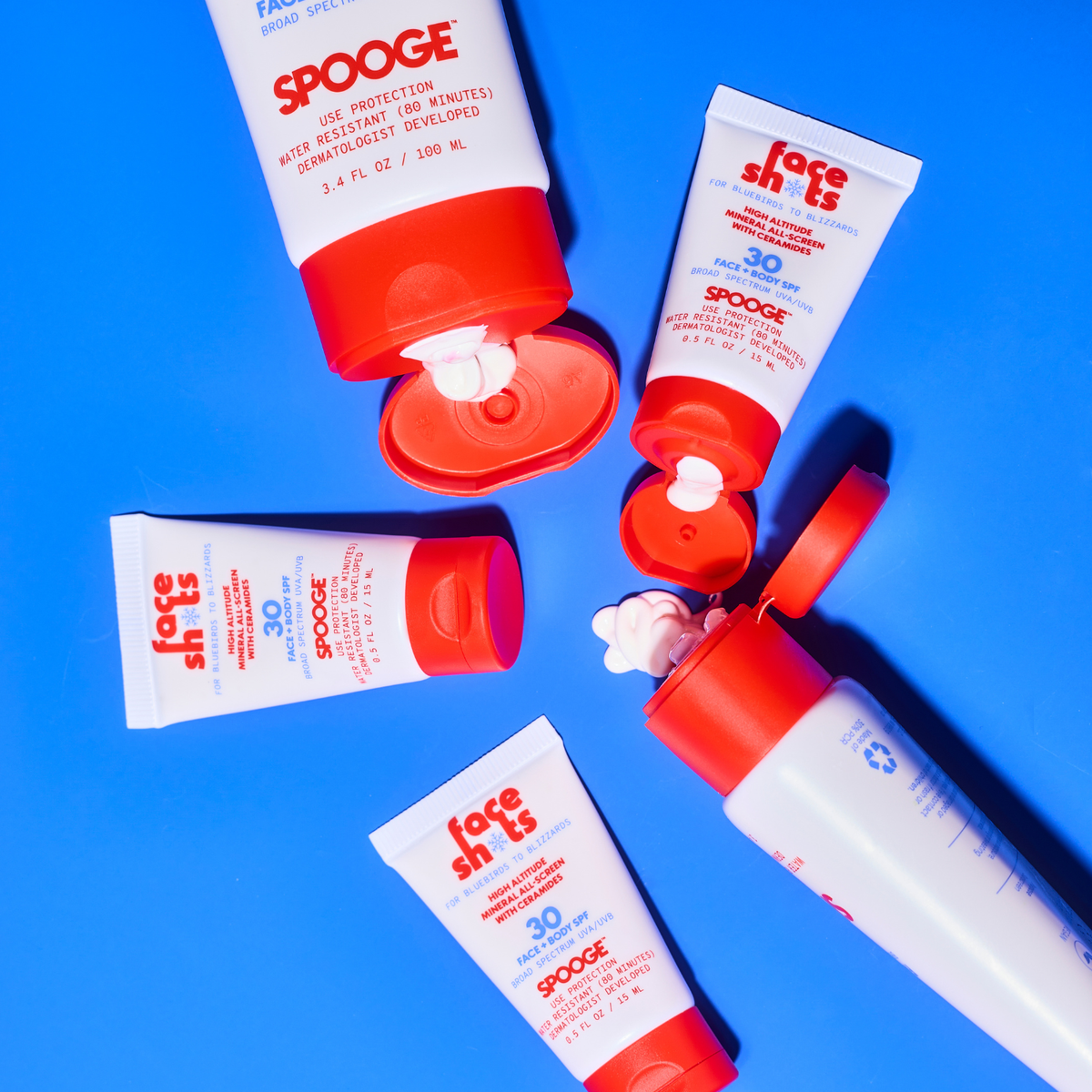
This community is a big part of why we created Face Shots by SPOOGE and partnered with athletes like Travis Ganong and Amie Engerbretson. Skiers and riders already have a gear culture. If sun protection is part of the gear, something you grab with your goggles and gloves, it actually gets used on the mountain.
It's everything. I can recommend the most protective sunscreen in the world, but if it feels greasy, leaves a white cast, stings the eyes, or breaks someone out, it won't get used. When people tell me they "hate sunscreen," they almost never mean they don't care about protection. They hate how a particular product felt or looked.
That was a big part of why I created SPOOGE. Physician-dispensed sunscreens are often excellent formulas, but many of them felt clinical, like a prescription. That works for a 60-year-old skin cancer patient who's already motivated, but not for a 20-year-old who's never had a reason to care. I wanted a product that had the credibility of being dermatologist-developed but that people actually wanted to put on, and to talk about. The fun, irreverent branding is intentional: if someone laughs, picks it up, and shows it to a friend, that's the beginning of a habit. I love that people comment that when they wear Cheeky that they catch a glimpse of shimmer that makes them happy. And I love when men who hate sunscreen try Ghosted for the first time and say "oh wow, I would wear that." That's the biggest complement of all.
My clinical experience is the reason SPOOGE exists. Every day in my Mohs practice, I'm treating the consequences of sun exposure that happened decades earlier. I wanted to reach people before they ever became my patients. That's also why our core channel is the professional and aesthetics world. SPOOGE is now carried in more than 150 medical spas and dermatology practices, because those providers are trusted voices and can put a product in someone's hands right at the moment they're thinking about their skin.
Building a consumer brand has absolutely changed how I approach patient education. I've learned that how you say something matters as much as what you say. Marketing taught me to think about the audience first: what they care about, what language they use, and what gets in the way of them acting. Now, in the exam room, I spend less time reciting risk statistics and more time asking about someone's routine and making sunscreen fit into it. I also have more humor in those conversations, and patients remember them.
The biggest lesson is that many people will never walk into a dermatologist's office on their own. Some don't have the time, some don't have access, and some simply don't think it applies to them. When we bring skin checks and sun protection to where people already are, whether that's a ski resort, or a community event, we reach people who would otherwise never get looked at.
Some of the most rewarding moments are reassuring someone that a spot they've been quietly worrying about for months is nothing to be concerned about. Often they never felt they could get it checked, because of time, cost, or not knowing where to go. In a few minutes, we can take away worry they've been carrying for months. That's a powerful reminder of why access matters.
These events also strip away the intimidation. When sun protection shows up in a fun, unexpected setting, people engage with it instead of tuning it out. A quick conversation and a free sample at the bottom of a ski run can do more for someone's habits than a pamphlet in a waiting room.

You must be 21 or older to enter this site. Please confirm your age to continue.
Sorry, you must be 21 or older to access this site.
You are being signed out…